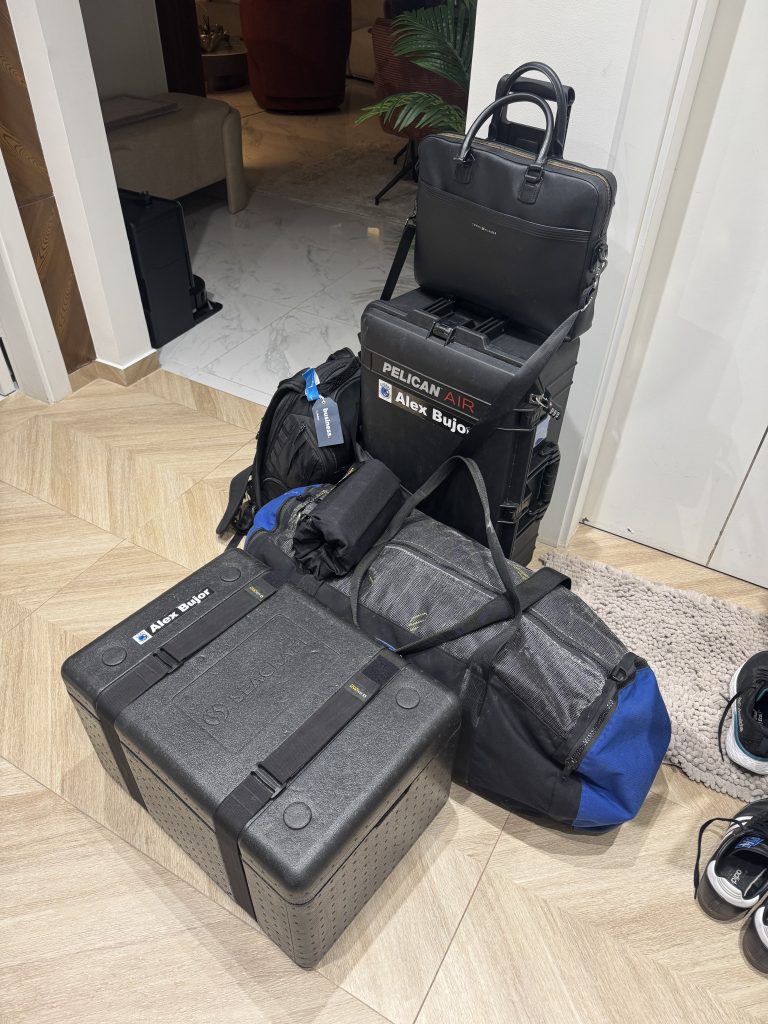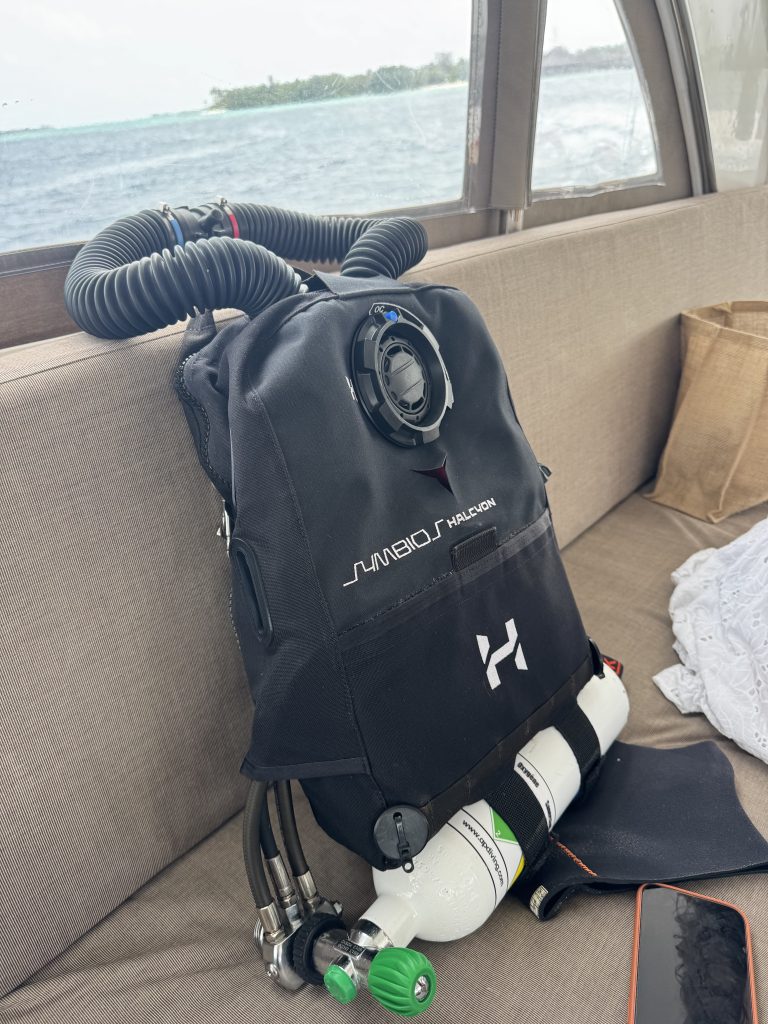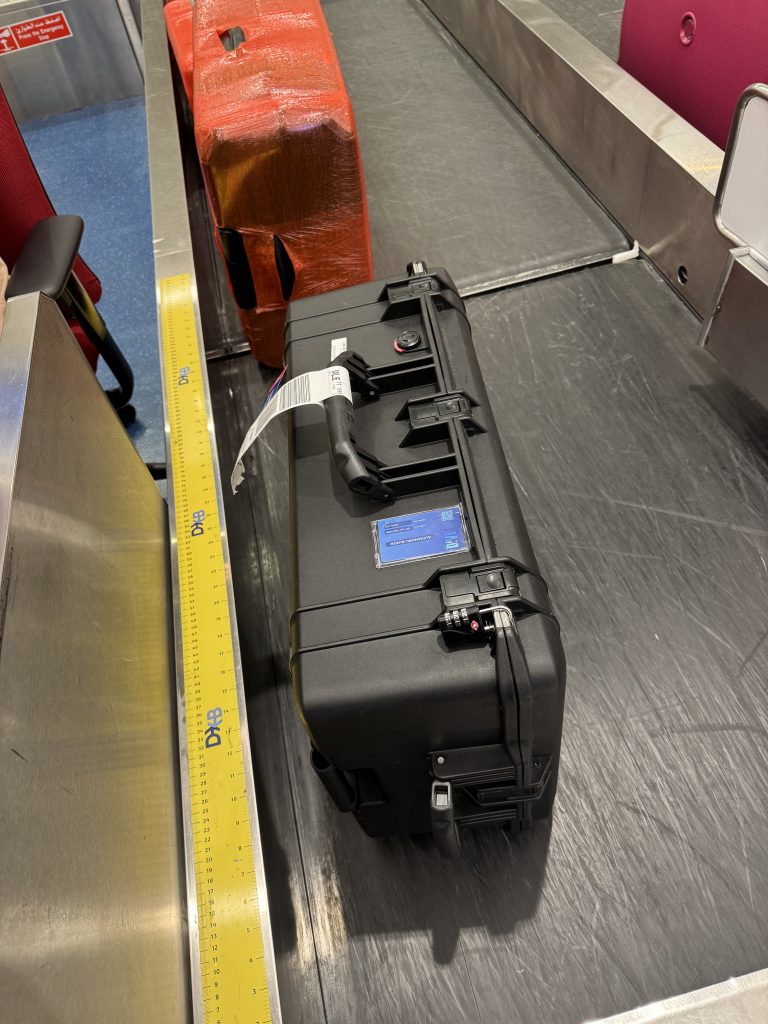

Travelling to the Maldives for diving is usually relatively straightforward. Travelling to the Maldives with four pieces of luggage, a CCR, a Seacraft DPV and most of your own diving equipment makes the journey slightly more interesting.
That was the plan for my recent trip from Dubai to Hurawalhi, in Lhaviyani Atoll: take my Halcyon Symbios CCR, take the equipment I normally dive with, and find out how practical it really is to travel to a Maldivian resort as a rebreather diver.
As it turned out, it was easier than I expected.
A Two-Hour Delay and an Unexpected Night in Malé
The trip started with a flight from Dubai to Malé that was delayed by around two hours. Unfortunately, those two hours were enough for me to miss my connecting seaplane to Hurawalhi. That meant spending an unexpected night in Malé.
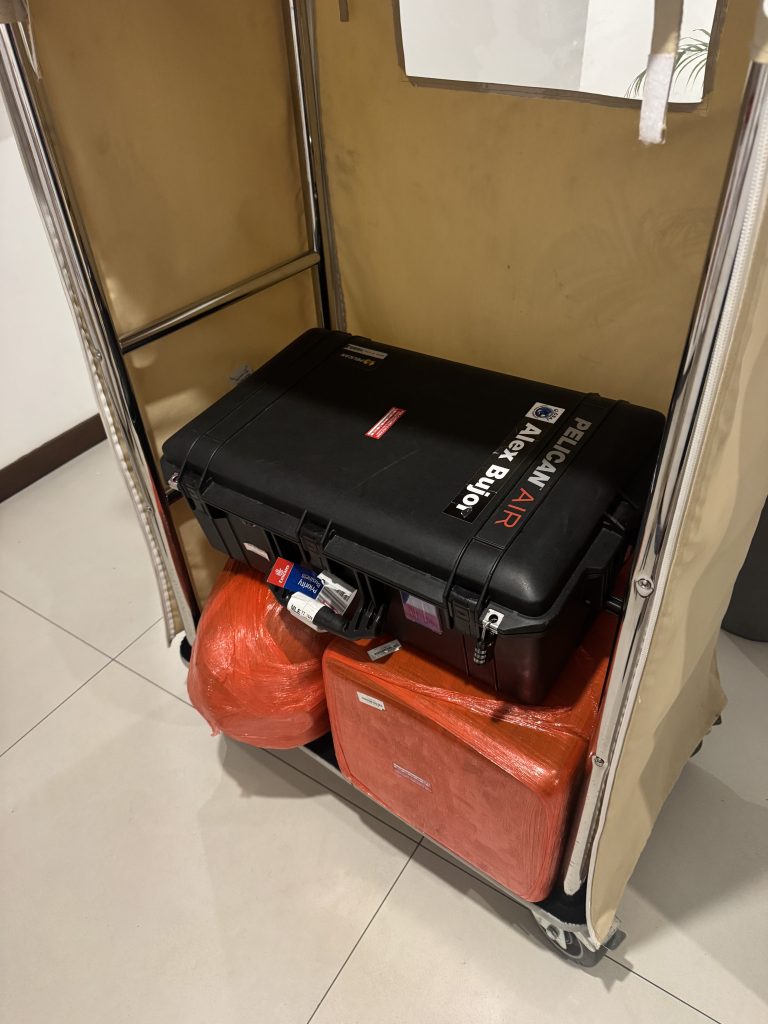
It could easily have become frustrating, particularly when travelling with four pieces of luggage, but this is also one of the things I have always appreciated about the Maldives. People are generally friendly, flexible and willing to help solve problems rather than create new ones. Finding a hotel for the night and moving everything around was surprisingly painless, even with all the diving equipment.
The two cases that were perhaps most interesting to Customs were, unsurprisingly, the ones containing the CCR and the Seacraft DPV. Both were marked for inspection. Still, the interaction with the Customs officers was easy. There were questions, the equipment was checked and that was essentially it.
Finally Reaching Hurawalhi
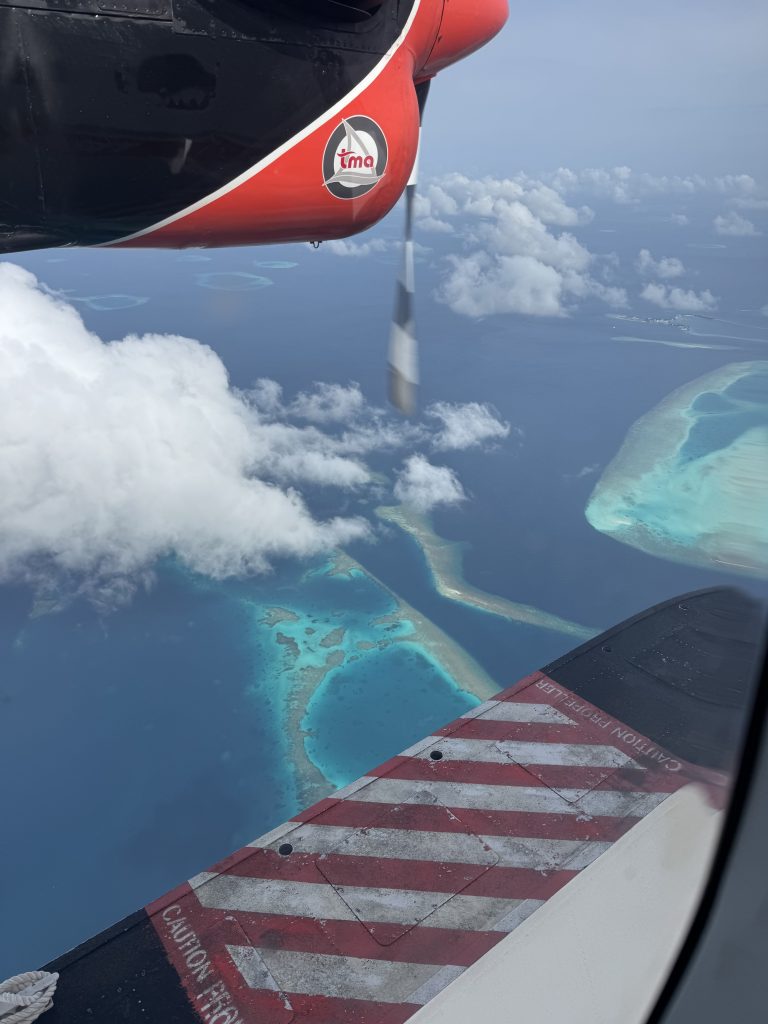
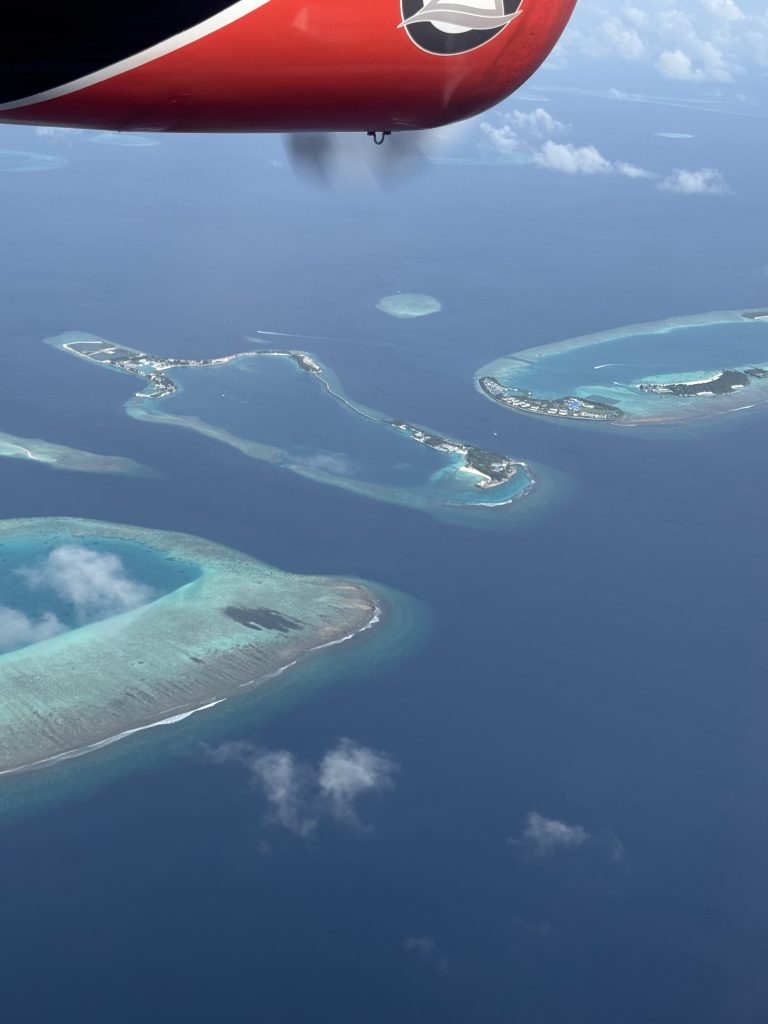
The next morning, we finally boarded the seaplane for Hurawalhi. After the previous evening’s delay, seeing the atolls appear below us made it feel like the trip was properly beginning. Around 40 minutes later we landed in Lhaviyani Atoll, where the Hurawalhi team was waiting for us.
The resort check-in was quick, and it didn’t take me long before I headed straight to Prodivers Hurawalhi. At that point my main interest was not the room or the beach — I wanted to see exactly what support they had available for the rebreather.
The First Question: Can They Support a CCR?
For a CCR diver travelling somewhere new, there is always one question sitting quietly in the back of your mind:
Can they actually support the unit?
You can carry almost everything yourself, but eventually you still need oxygen and scrubber material. Fortunately, the answer at Hurawalhi was YES. The dive centre had Sofnolime, together with both 2-litre and 3-litre cylinders suitable for oxygen.
Pure oxygen is filled on nearby Kuredu Island, which is only a short boat ride away and boats move regularly between the two islands. That means the basic logistics for oxygen fills are already in place.
After the trip, I asked Prodivers Hurawalhi to confirm their available CCR cylinders for this article. They told me that they currently have:
- Four sets of 2-litre cylinders
- Five sets of 3-litre cylinders
Each set consists of one oxygen cylinder and one air cylinder, with the oxygen bottles sent to Kuredu for filling.
That is valuable information if you are thinking about bringing your own CCR to Hurawalhi. You still need to contact the dive centre before travelling and confirm availability for your specific dates, but the support exists.
Interestingly, CCR divers are apparently still relatively uncommon visitors as the staff told me they might see only two or three CCR divers per year. The upside is that when one arrives, there is genuine enthusiasm around it.
Nine Dives and Almost Every Version of the Maldives
Between 16 and 20 August 2026, I completed nine dives with Melanie and the Prodivers Hurawalhi team and the logbook shows just how varied the week became.
We started at Kanihura Outer Reef, followed by Latheef Reef and Kukulu, with all three dives reaching around 30 metres. Then came Fushivaru Corner and Kuredu Express, where the character of Maldivian current diving became much more obvious. Later we explored Peak, followed by a night dive at Kuredu House Reef for a night dive.
The final day brought us to Xpress Channel, with another dive close to 30 metres, before finishing the trip at Fushivaru Thila where we spotted no less than 3 mantas.
The dives lasted roughly 50 to 64 minutes, with most of the deeper ones sitting close to the 30-metre recreational limit, but the numbers only tell part of the story. Across those nine dives we experienced almost everything I had hoped for from the Maldives.
We had current dives where the Seacraft DPV became extremely useful. In strong current, I found the DPV particularly valuable because it gave me flexibility. A reef hook fixes you to one location. With the DPV, I could move, reposition myself or help another diver without becoming completely dependent on whatever the current decided to do.
Then we had the complete opposite: relaxed dives where we slowly explored reefs and overhangs.
And sharks! There was a night dive with blacktip sharks. There were daytime encounters with grey reef sharks.
And on the final dive of the trip, at Fushivaru Thila, we had the fireworks: mantas gliding gracefully in the current for cleaning. It felt like the perfect way to finish. After five days of very different diving, it was almost as if the Maldives had saved one of its best experiences for the end.
| Date | Dive site | Max depth | Dive time |
|---|---|---|---|
| 16 Aug | Kanihura Outer Reef | 30 m | 52 min |
| 17 Aug | Latheef Reef | 30 m | 60 min |
| 17 Aug | Kukulu | 30 m | 60 min |
| 18 Aug | Fushivaru Corner | 30 m | 59 min |
| 18 Aug | Kuredu Express | 30 m | 60 min |
| 19 Aug | Peak | 27.5 m | 60 min |
| 19 Aug | Kuredu House Reef | 22.3 m | 51 min |
| 20 Aug | Xpress Channel | 29 m | 62 min |
| 20 Aug | Fushivaru Thila | 16 m | 64 min |
Why the CCR Made Sense in the Maldives
Bringing a rebreather across international borders is obviously more complicated than renting a single cylinder and BCD when you arrive. But once I was actually diving, the advantages became very obvious.
The first was simple logistics. During the entire trip, I changed my CCR cylinders only twice. That alone is convenient compared with changing cylinders after essentially every recreational open-circuit dive.
The second advantage became noticeable on dives where we spent significant time around 30 metres. Gas consumption simply stops being the constant background consideration it is on open circuit. That does not remove the need for proper gas planning, particularly bailout planning, but it changes the way you experience the dive. You can relax and observe rather than continuously watching a rapidly falling cylinder pressure.
One dive demonstrated another advantage in a much more practical way. A diver with me became low on gas and asked for assistance. I donated gas from my open-circuit supply. At that moment, my cylinder still showed approximately 180 bar and that for both of us was reassuring. Instead of donating from another diver who might also have consumed a substantial part of their gas supply, there was a large reserve available immediately.
It was a good example of how equipment configuration can provide useful options when something unexpected happens.
And Then There Is the Silence
The other advantage is much less mathematical.
CCR diving is quiet. Really quiet. There are no continuous streams of bubbles announcing your presence every few seconds.
When you separate yourself slightly from the open-circuit group, the difference becomes obvious. Marine life doesn’t rush to get away from you. You can stay still, watch, wait. And sometimes get surprisingly close.
In a place such as the Maldives, where so much of the experience revolves around sharks, mantas, turtles and other marine life, that silence changes the character of the dive. And that for me has become one of the most enjoyable parts of rebreather diving.
The Backup Plan Hidden in My Symbios Setup
There was another lesson from this trip that had less to do with actually diving the CCR and more to do with travelling with one.
My Halcyon Symbios configuration is particularly useful for this.
For Hurawalhi, I brought:
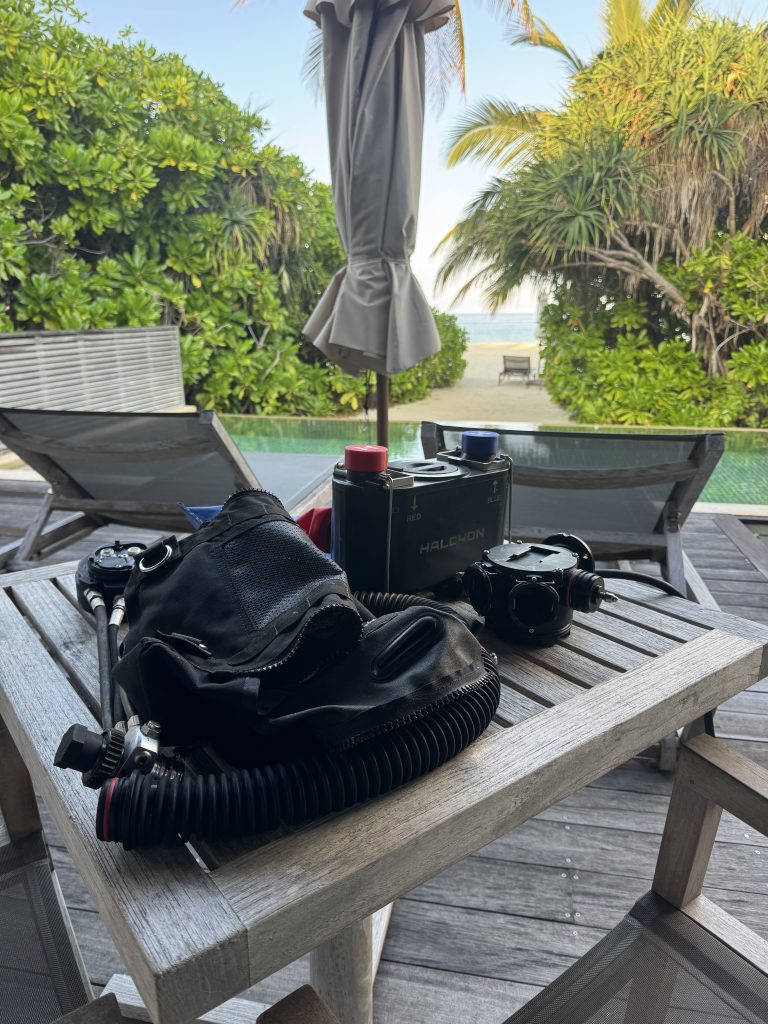
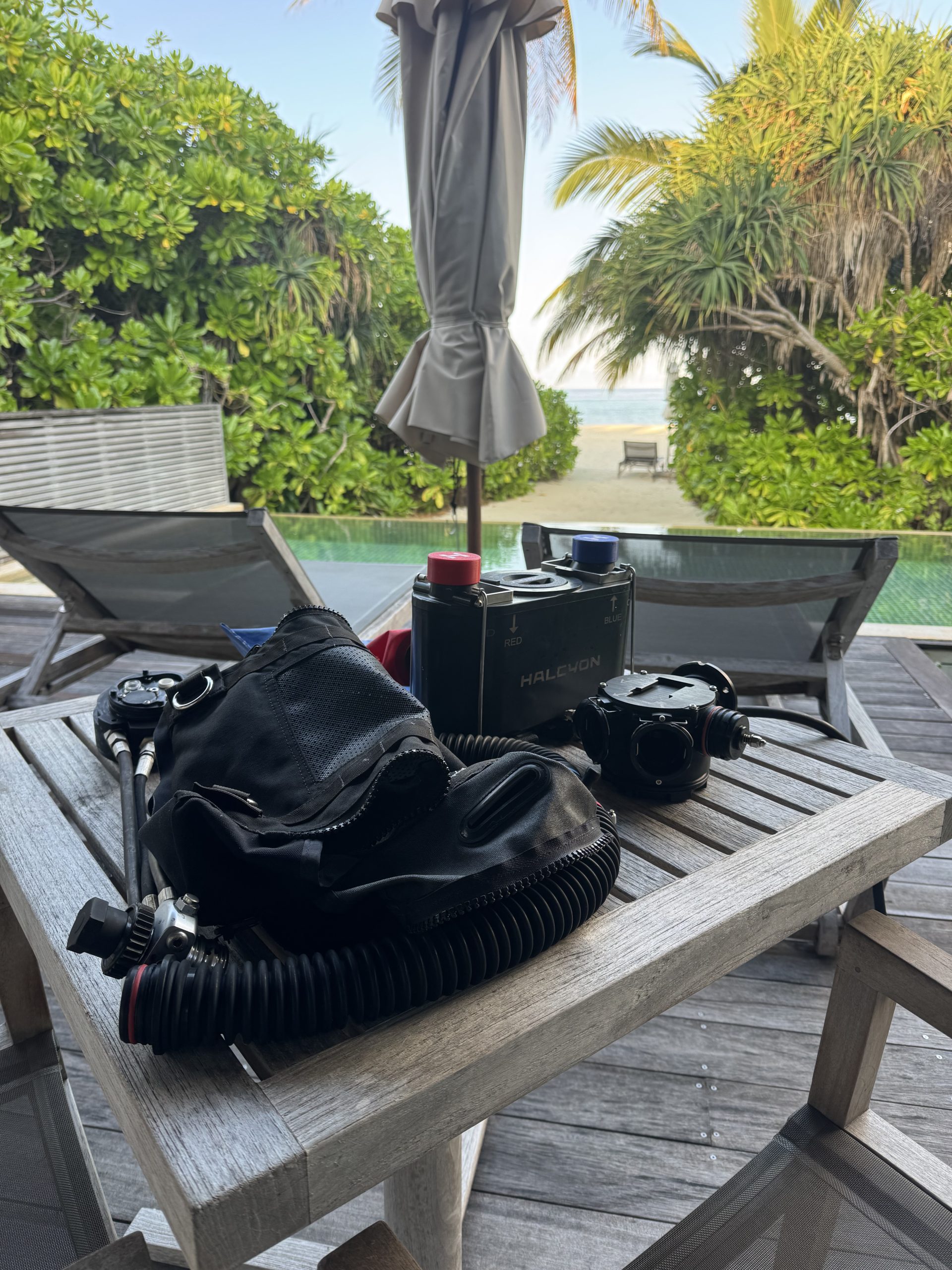
- One steel backplate and wing
- One regulator configured in a long-hose recreational setup
- An additional hose supplying diluent to the Symbios
- The CCR itself
What I particularly like about this configuration is that the backplate, wing and regulator are not trapped inside a CCR-only system. Remove the rebreather and I effectively have a normal open-circuit diving configuration. I don’t need another BCD or regulator. I don’t need to rebuild everything.
That is an extremely powerful backup when travelling. Imagine arriving at a remote destination and discovering that the oxygen logistics have changed, the sorb you expected is not available, or something specific to your CCR cannot be supported. With some rebreather configurations, that could seriously compromise the diving part of the holiday. With the Symbios setup I travelled with, I could simply remove the CCR and go diving on open circuit, nothing else fundamentally changes.
That flexibility is something I appreciate much more after actually travelling with the system.
Heading Home
After five days and nine dives in Hurawalhi, it was time to pack everything again.
The journey took us back to Malé and then, later that evening, back to Dubai.
And after worrying about moving a CCR and DPV through two countries, the final surprise came at Dubai Customs:
Nobody seemed particularly interested in either of them.
The luggage arrived, I collected everything, and I walked out.
In the end, I had managed to travel from Dubai to a relatively remote Maldivian island, complete nine dives on my own CCR, use my own DPV, and return home without any serious logistical problem.
Probably the most frequently repeated procedure throughout the entire trip wasn’t explaining the rebreather to Customs.
It was counting:
One, two, three, four. Are all my bags still here?
What I Would Do Again
Hurawalhi proved to me that travelling to the Maldives with a CCR is entirely realistic when the logistics are confirmed in advance. Prodivers already had the two things that are difficult to bring yourself: oxygen support and Sofnolime. Everything else was mostly normal expedition planning.
For me, the combination worked extremely well: a CCR for efficiency and silence, a DPV for flexibility in current and an equipment configuration that could immediately become a conventional open-circuit setup if the rebreather could not be supported.
Maldives added the rest. Strong currents. Overhangs. An amazing sunset just before diving with blacktip sharks at night. Grey reef sharks surrounding us during the day. Mantas on the final dive. Nine dives were not enough to see everything, but they were enough to make me want to return.
This time, perhaps with slightly less concern about Customs — and exactly the same concern about making sure all four pieces of luggage make it onto the next flight.